
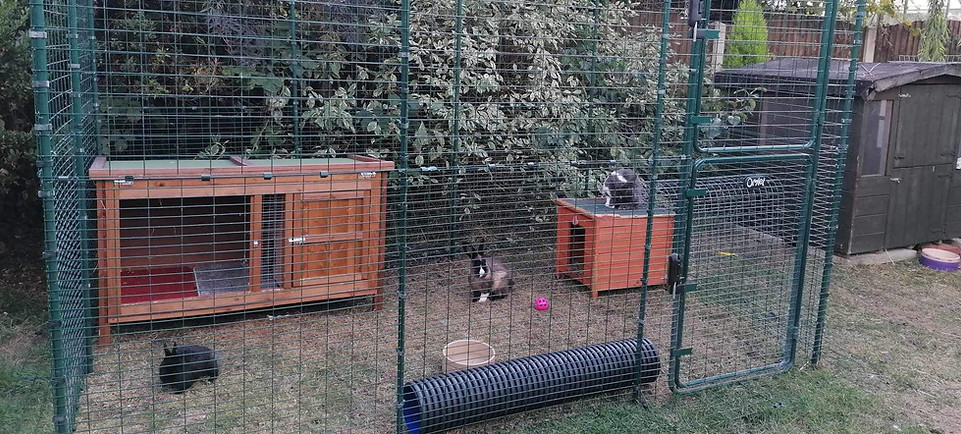
Thinking about getting your first rabbits?
Or perhaps you need to brush up on the basics....
Rabbit care has come a long way from when a single rabbit was housed in a tiny hutch at the bottom of the garden and our knowledge is always improving therefore so is the care we implement for them. So here is a guide for all owners; both those new to rabbits and those returning to taking care of them.
Before you rush out to collect your new pets, PLEASE RESEARCH there are a lot of mistruths regarding their care. Some things that you will need to think about or prepare beforehand....
Remember rabbits are the third most popular pet in the UK but also the most neglected. This is mainly due to people not doing their research.
Rabbit housing
Where are your rabbits going to live? Indoors with you or outdoors in a secure sheltered space?
For two rabbits (and they need to be kept in at least pairs, read more here) the minimum welfare requirement, whether they live indoors or out is that they have 24 hour access to an enclosed area of at least 3m x 2m by 1m high (approx. 10' x 6'6" x 3'4"). This can include the sleeping quarters. This minimum space should be across one floor / level not made up of two floors. Any second floor space should be not be counted in the above equation.
The sleeping quarters (hutch for example) should be a minimum of 1.8m x 0.6m x 0.6m high (or 6ft x 2ft x 2ft)
If your rabbits are to be kept outside then the floor of their sleeping quarters needs to be lined with soft bedding such as straw, fleece blankets, vet bed or carpet. These need to be kept an eye on for any chewing (this behaviour generally reduces when the rabbits have the correct space as this aids stimulation and prevents frustration and boredom).
Sawdust and wood shavings are NOT to be used at all as it is an irritant to their eyes and respiratory system.
.jpg)
Handling your rabbits
Most people believe that handling rabbits whilst they are young gets them used to human contact which can work but could also have the opposite affect with rabbits who have a high survival instinct. The main thing to remember with rabbits is that they are prey animals. The experience of being picked up can be terrifying for them as it imitates them being caught by a predator and can hinder any trust being built with them. You can read more on this here.
We do not handle our rabbits unless we have to. Rabbits are intelligent and quickly realise when they see you that they will be picked up so run and hide which is obviously not what we want. To build up trust you need to sit on the floor at your rabbits’ level and let them approach you, offer them treats and make the experience a positive one for them. This may take time to begin with as is it can take up to a few months for your rabbits to fully settle in their new home.
We do not advise buying from a breeder or pet shop but should you bring rabbits home under 3 months old handling is a good idea at this age to familiarise them with people and minimise stress when older and when they need to be picked up for health reasons. Please ensure this is done safely for example do not stand up with them in case they make a run for it and jump from your arms and as much as possible on the rabbits terms. DO NOT attempt to chase them around their home to do this.
They have powerful back legs and if they are not handled correctly can kick out in an attempt to escape and can break their own spine.
If you need to get your pets into a carrier case for vet visits for instance it is always best to coach them into the case rather than picking them up to place inside. Rabbits are naturally inquisitive so many may go in on their own accord, some may need a little more convincing.
When given the space they need and a friend to interact with (these are basic welfare needs) you quickly see they have their own personalities and can be just like a small dog.

Diet
Rabbits are very high maintenance pets and have very specific dietary needs that need to be adhered to as a lot of health issues are caused by the wrong diet.


Below you will find some basic facts you should know before considering welcoming rabbits into your home.
Knowing your rabbits
-
The average life expectancy of a rabbit is around 10 years; this can vary greatly depending on many factors including the living conditions and diet.
-
They are engaging and enjoyable Pets … but lonely when kept singularly, your little furry 'friend' needs their own friend. Read more about companionship here
Housing
-
'A hutch is NOT enough'
-
Consider whether your rabbits will be living indoors or outdoors
-
Their enclosure should be a minimum of 3m x 2m x 1m high
-
Rabbits and guinea pigs should NEVER be kept together
Read more about housing needs here
Health & Care
-
They are a prey animal and most rabbits do NOT like being picked up and cuddled
-
Rabbits dislike fast movements and loud sounds
-
They are clean animals and can be litter trained; this is usually more successful once they have been neutered
-
Litter boxes should be cleaned out every day especially in warmer months so you can keep an eye on their droppings (this can tell you a great deal about their health); and also help protect them from Fly Strike
-
Rabbits have an extremely sensitive digestive system which can easily cause severe illness through poor diet. They need to have a constant, unlimited supply of hay (not to be confused with straw)
-
They should NOT be fed the ‘muesli’ type food that some shops / supermarkets still sell as rabbit food. Good quality pellets in limited portions should be given instead
-
A rabbit’s health depends on their digestive system working continuously; simply put they need to eat throughout the day. If they don’t eat their digestive tract will stop working and they can go into a state known as GI Stasis. This can be fatal if not treated in time so getting to know your rabbits’ habits is important for early detection
-
Not all vegetables are suitable for rabbits – in particular Iceberg lettuce has no nutritional value and can cause serious gut problems. In fact, we no longer feed our rabbits vegetables – herbs are an exception
-
Carrots are also a once in a while treat in small quantities – they are full of sugar and can lead to obesity in a rabbit; as are any safe fruits
-
Their teeth never stop growing this is another reason why they need to eat hay to keep them trimmed
-
Rabbits have a delicate bone structure which can easily be damaged by the incorrect holding of them or by being accidently stepped on
Read more about healthcare here
Illnesses
-
Rabbits hide their illness / pain in order to not attract predators to their weakness, so it isn’t always obvious that there is a problem; again, getting to know their habits can help with earlier detection
-
Unlike cats and dogs, you should never wait for a ‘day or two’ to see if they get better; by then your rabbit may well have died as by the time they show their illness it is usually progressed to the latter stages
-
No rabbit should be ‘starved / fasted’ prior to an operation – if you are told to do this by your Vet / Receptionist at the vet practice tell them they are wrong and consider changing to a different veterinary clinic
-
Female rabbits have an 80% chance of having uterine (womb) cancer if not spayed early enough
-
Veterinary care is very expensive for any animal and as rabbits are classed as ‘exotic’ pets a rabbit savvy vet may be some distance from your home
-
Sadly, not all vets are experienced or knowledgeable enough to treat rabbits correctly. This is due to people thinking ‘they’re just rabbits’ and are not worth taking to the vets; therefore, vets don’t get the same volume of experience that they do with the many cats and dogs they see. Inevitably they have to work from what they have learnt from a text book which sadly isn’t always enough. You need to find out where your nearest ‘rabbit savvy’ vet is before you need them
-
Rabbit insurance only covers certain things so check out what is omitted before signing up. Not doing so can be a costly mistake
We highly recommend that you adopt your rabbits from a reputable rescue. There is a stigma that rescue rabbits are 'broken rabbits'. Either having ill health or behavioural problems. This isn’t true, the majority of rabbits that join us do so through no fault of their own. Reputable rescues want what is best for both rabbits and owner so will be upfront with any issues the rabbits may have.
The welfare of all animals is protected by law under the Animal Welfare Act 2006 which sets out the five basic welfare needs.
The 5 basic welfare needs required for pets:
-
Need for a suitable environment
-
Need for a suitable diet
-
Need to be able to exhibit normal behaviour patterns
-
Need to be housed with, or apart, from other animals
-
Need to be protected from pain, suffering, injury and disease
